
With COP31 taking place this week in Antalya, it is remarkable to look back just five years and see how far climate issues have fallen from the political agenda on the island of Ireland.
In the early 2020s, the “green wave” delivered what was supposed to be a watershed moment for climate action, in the form of legally binding targets to achieve net zero greenhouse gas emissions by 2050. In the Republic, where the Greens were a junior coalition partner in government, the Climate Act was signed into law in July 2021; and at Stormont, the Greens reached a compromise with the DUP to pass the Climate Change Act in March 2022, just ahead of the Assembly election.
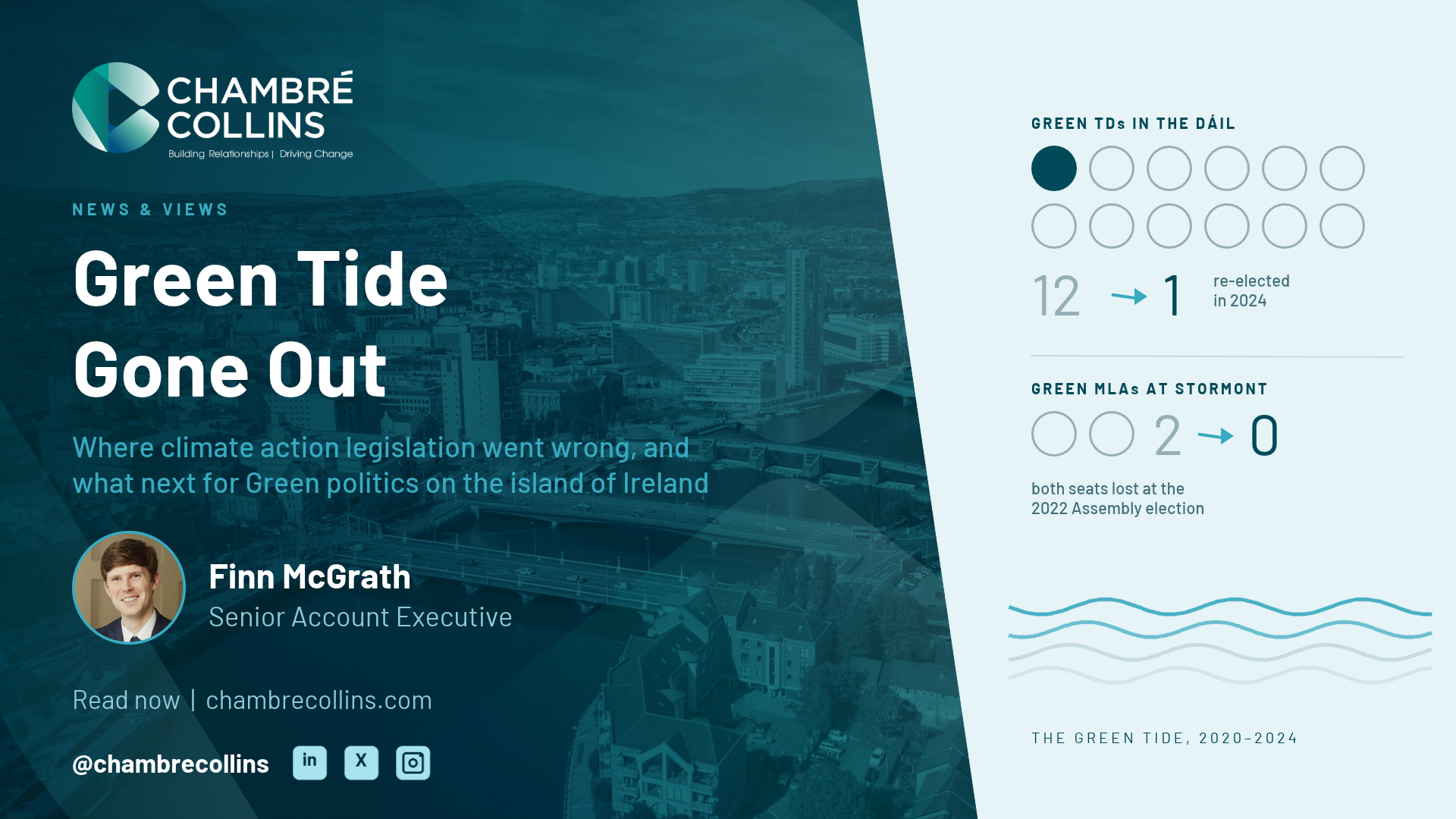
These legislative victories were supposed to “turn climate ambition into law”, as Eamon Ryan, then Green Party leader and Minister for the Environment, Climate and Communications, said at the time. Both laws contain a similar mechanism – Section 15 of the Climate Act in the Republic, covering all public bodies, and Section 52 of the Climate Change Act in NI, covering government departments – requiring the public sector to act in a manner consistent with statutory emissions reduction targets. This was supposed to lock climate action into public policy, even if the Greens lost power – as they did when both Green MLAs lost their seats at Stormont in 2022, and just one of twelve Green TDs was re-elected to the Dáil in 2024.
However, neither piece of legislation has had the enduring impact that the Greens had hoped for. Neither jurisdiction is expected to hit its 2030 targets for emissions reductions or renewable energy generation. Moreover, both the current Irish Government and the parties in the Northern Ireland Executive have chafed against the restrictions imposed on government departments by climate laws.
One area where this is plain to see is infrastructure. In the Republic, earlier this year the coalition government passed new legislation allowing specific projects to be designated as “critical infrastructure”, exempting them from Section 15 of the Climate Act. The Irish Government hopes that this will accelerate the delivery of long-promised projects, such as MetroLink, the Galway City Ring Road, the North-South interconnector, and major improvements to wastewater services.
In the north, the implications of the Climate Change Act have played out in a court battle over the upgrade of the A5 dual carriageway. Last year, a judge ruled in favour of a challenge by campaigners, who alleged that the Department for Infrastructure’s plans for the road did not comply with climate change targets. This was appealed by the Minister, Sinn Féin’s Liz Kimmins. Last month, the judgment was overturned, with the Lady Chief Justice, Dame Siobhan Keegan, saying the project “is a priority investment and should be proceeded with”.
In retrospect, the legalistic approach to climate action was a mistake. The language of binding targets, and constraints on the government’s ability to act, seems hugely dated just a few years on. To be fair to the Greens, they could not have foreseen everything that has happened since. The war in Iran has shown the urgent need to reduce our reliance on fossil fuels, but it has also driven up the cost of living in ways that are acutely felt by the public.
Voters, including those on the centre and progressive left who may have left the Greens at the most recent elections, are demanding greater action from government, including on issues like the cost of living and infrastructure delivery. This is reflected in the success of politicians like Andy Burnham and Zohran Mamdani, who focus on tangible, practical policies.
There are some positive signs from COP31 that the green movement has learned similar lessons. Host nation Turkey has put electrification at the centre of its agenda, which involves a major expansion in the use of electricity to power transport, heat buildings and operate industrial processes. It has a snappy pledge, ‘35 by 35’, referring to electricity making up 35% of global energy consumption by 2035. And, as ever with COP, there is compromise: it is unlikely that the pledge will require electricity to come from low-carbon, renewable sources.
Yet the electrification agenda puts the positive and tangible impacts of climate action front and centre. For example, expanding retrofitting grants and rolling out heat pumps as an alternative to gas and oil boilers will make homes warmer and healthier. More electric vehicles and clean industry will improve air quality. And crucially, electrification is a way to bring down costs in the present, not just avoid future ones. The discussions have also focused on how governments can go further, and how to address constraints like grid capacity. If Green politics is to make a comeback on the island of Ireland, it should learn from the disappointing returns from its flagship climate legislation. Green parties must deliver climate action, not climate restrictions.
Finn McGrath is a Senior Account Executive at Chambré Collins.